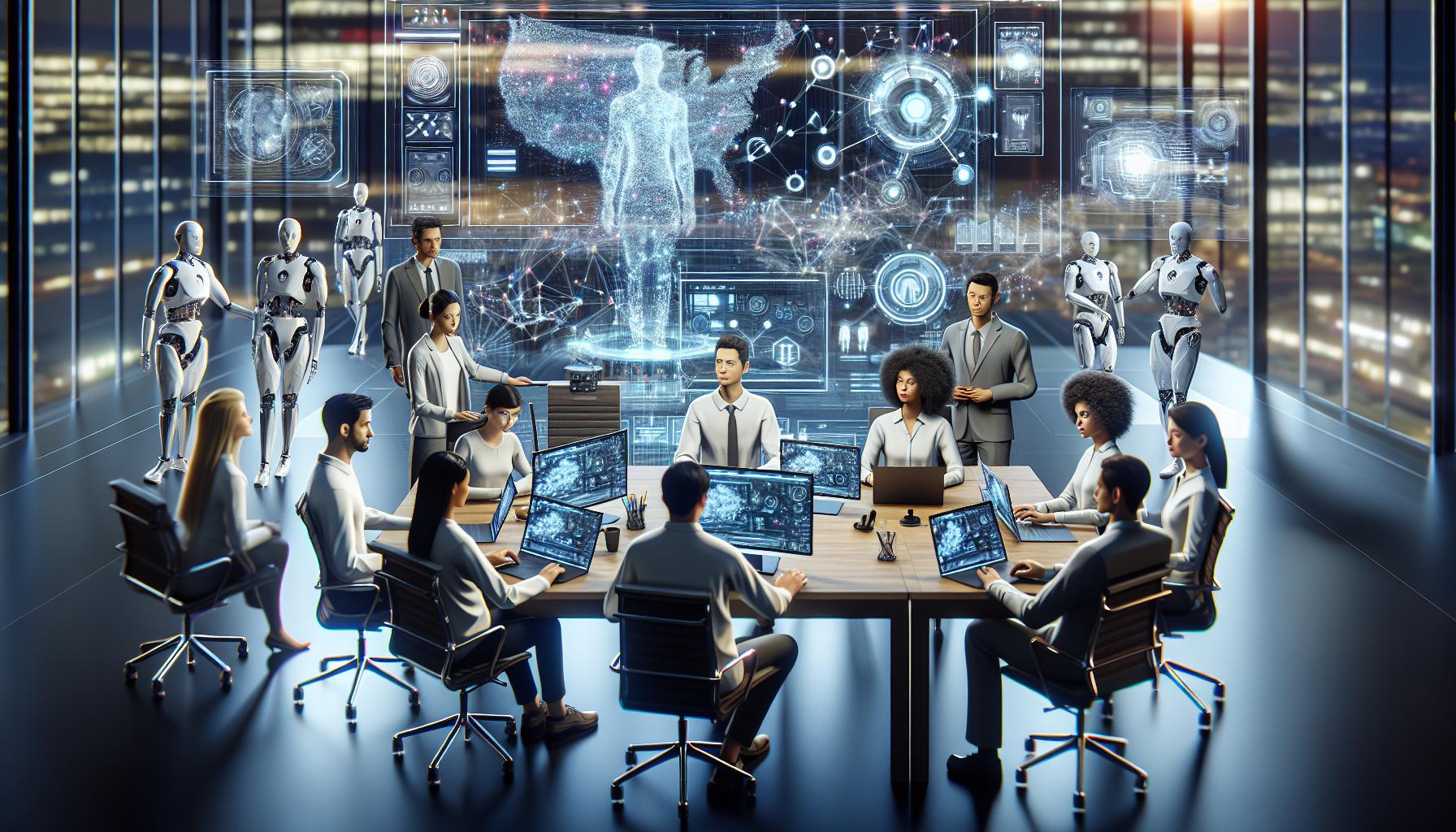

We’re on the cusp of a technological revolution that’s reshaping our world at an unprecedented pace. Artificial Intelligence, once confined to the realm of science fiction, is now a tangible force driving innovation across industries and transforming the way we live and work.
From healthcare to finance, manufacturing to entertainment, AI’s impact is far-reaching and profound. As we navigate this new landscape, we’re witnessing remarkable advancements in machine learning, natural language processing, and robotics. These developments aren’t just automating routine tasks; they’re augmenting human capabilities and opening doors to possibilities we’ve only begun to imagine.
In this article, we’ll explore the current state of AI, its potential implications for society, and the challenges we face as we embrace this transformative technology. Join us as we delve into the AI revolution and its role in shaping our future.
Key Takeaways
- AI is transforming industries across healthcare, finance, manufacturing, and more, driving innovation and efficiency
- Key technologies like machine learning, natural language processing, and computer vision are propelling the AI revolution
- Ethical considerations, including privacy concerns and job displacement, are crucial challenges in AI development
- The future of AI promises advancements in quantum AI, neuromorphic computing, and seamless integration into daily life
- Preparing for the AI revolution requires focus on education, skill development, and adaptive policy frameworks
The Dawn of the AI Revolution
The AI revolution has ushered in a new era of technological advancement, transforming industries and reshaping our daily lives. This groundbreaking shift in technology is driven by rapid progress in machine learning algorithms, increased computing power, and vast amounts of available data.
AI’s impact is far-reaching, touching nearly every sector of the economy:
- Healthcare: AI-powered diagnostics and personalized treatment plans
- Finance: Automated trading systems and fraud detection
- Manufacturing: Smart factories and predictive maintenance
- Transportation: Self-driving vehicles and optimized logistics
- Retail: Personalized recommendations and inventory management
As AI continues to evolve, we’re witnessing the emergence of more sophisticated applications. Natural language processing enables machines to understand and generate human-like text, while computer vision allows AI systems to interpret and analyze visual information with unprecedented accuracy.
The AI revolution isn’t just about automation; it’s about augmenting human capabilities. AI tools are empowering professionals across various fields to make better decisions, work more efficiently, and tackle complex problems that were previously insurmountable.
However, this transformative technology also brings challenges:
- Ethical considerations
- Job displacement concerns
- Data privacy issues
- Algorithmic bias
As we navigate the dawn of the AI revolution, it’s crucial to address these challenges proactively and ensure that the benefits of AI are distributed equitably across society.
Key Technologies Driving the AI Revolution
The AI revolution is propelled by several groundbreaking technologies that form the backbone of intelligent systems. These innovations enable machines to learn, understand, and perceive the world in ways that were once the exclusive domain of human intelligence.
Machine Learning and Deep Learning
Machine learning and deep learning are at the forefront of the AI revolution. These technologies empower computers to learn from data without explicit programming. Machine learning algorithms identify patterns in large datasets, while deep learning, a subset of machine learning, uses neural networks to simulate human-like decision-making processes. Applications range from predictive analytics in finance to personalized recommendations in e-commerce platforms.
Natural Language Processing
Natural Language Processing (NLP) enables machines to understand, interpret, and generate human language. This technology powers virtual assistants, chatbots, and translation services. Advanced NLP models can comprehend context, sentiment, and even subtle nuances in text, revolutionizing how we interact with machines and breaking down language barriers in global communication.
Computer Vision
Computer vision allows AI systems to interpret and analyze visual information from the world. This technology is crucial in facial recognition systems, autonomous vehicles, and medical imaging diagnostics. Computer vision algorithms can process and analyze images and videos with remarkable accuracy, often surpassing human capabilities in speed and precision. It’s transforming industries from retail to healthcare, enabling applications like automated quality control in manufacturing and AI-assisted medical diagnoses.
AI Revolution Across Industries
The AI revolution is reshaping industries worldwide, driving innovation and efficiency. We’re witnessing transformative changes across various sectors, with AI technologies enhancing processes and decision-making.
Healthcare and Medicine
AI’s impact on healthcare is profound, revolutionizing patient care and medical research. Machine learning algorithms analyze vast datasets to aid in disease diagnosis and treatment planning. AI-powered imaging systems enhance the accuracy of medical scans, detecting anomalies that human eyes might miss. Robotic surgical assistants improve precision in complex procedures, reducing risks and recovery times. AI also accelerates drug discovery by simulating molecular interactions and predicting potential therapeutic compounds.
Finance and Banking
The financial sector has embraced AI to streamline operations and enhance customer experiences. AI-driven algorithms power high-frequency trading, analyzing market trends in milliseconds to execute trades. Fraud detection systems use machine learning to identify suspicious transactions in real-time, protecting consumers and institutions. Chatbots and virtual assistants provide 24/7 customer support, handling inquiries and basic transactions. AI also enables personalized financial advice, analyzing individual spending patterns and market conditions to offer tailored investment strategies.
Manufacturing and Robotics
AI and robotics are transforming manufacturing processes, ushering in the era of smart factories. Autonomous robots collaborate with human workers, handling repetitive tasks and improving production efficiency. Machine learning algorithms optimize supply chain management, predicting demand fluctuations and minimizing inventory costs. AI-powered quality control systems detect defects with greater accuracy than traditional methods, reducing waste and improving product quality. Predictive maintenance powered by AI analyzes equipment data to anticipate failures, reducing downtime and extending machinery lifespan.
Ethical Considerations in the AI Revolution
As AI continues to reshape our world, it’s crucial to address the ethical implications of this transformative technology. The AI revolution brings forth a range of complex ethical challenges that require careful consideration and proactive measures to ensure responsible development and deployment.
Privacy and Data Security
AI systems rely heavily on vast amounts of data, raising significant concerns about privacy and data security. Machine learning algorithms often require access to personal information to function effectively, potentially compromising individual privacy. We’re seeing an increased need for robust data protection measures and transparent data collection practices. Companies must implement stringent security protocols to safeguard sensitive information from breaches and unauthorized access. Additionally, there’s a growing demand for AI systems that can operate on anonymized or encrypted data to minimize privacy risks.
Job Displacement and Economic Impact
The AI revolution is reshaping the job market, leading to both job creation and displacement. While AI automates routine tasks, it’s also generating new roles in AI development, data analysis, and machine learning. However, certain industries face significant workforce disruption. We’re observing a shift in skill requirements, with a growing emphasis on AI literacy and adaptability. To mitigate the economic impact, it’s essential to invest in reskilling and upskilling programs. Policymakers and businesses must collaborate to create strategies that ensure a smooth transition for workers affected by AI-driven automation, fostering an inclusive AI revolution that benefits all segments of society.
The Future of AI: Opportunities and Challenges
As the AI revolution continues to unfold, we’re witnessing an unprecedented era of technological advancement. The future of AI promises both exciting opportunities and significant challenges that we must navigate carefully.
Expanding Frontiers of AI
AI’s potential extends far beyond its current applications. We anticipate breakthroughs in:
- Quantum AI: Combining quantum computing with AI to solve complex problems at unprecedented speeds
- Neuromorphic Computing: AI systems that mimic the human brain’s neural structure
- Explainable AI: Developing AI models that can clearly articulate their decision-making processes
These advancements will likely accelerate the AI revolution, opening new frontiers in scientific research, healthcare, and technological innovation.
AI in Everyday Life
The integration of AI into our daily lives will become more seamless and pervasive:
- Smart Homes: AI-powered systems managing energy consumption, security, and household tasks
- Personalized Education: AI tutors adapting to individual learning styles and paces
- Augmented Reality: AI enhancing our perception of the world through advanced AR technologies
As AI becomes more ubiquitous, it’ll reshape how we interact with technology and our environment.
Ethical Considerations and Governance
The rapid advancement of AI technology raises crucial ethical questions:
- AI Decision-Making: Ensuring fairness and transparency in AI-driven decisions
- Privacy Concerns: Balancing data collection for AI improvement with individual privacy rights
- AI Rights: Addressing the potential rights of highly advanced AI systems
Developing robust ethical frameworks and governance structures for AI will be essential to harness its benefits while mitigating potential risks.
Economic Impact and Workforce Transformation
AI’s economic impact will be profound:
- Job Market Shifts: Creating new roles in AI development while automating others
- AI-Driven Innovation: Spurring new industries and business models
- Global Competition: Intensifying the race for AI dominance among nations
Adapting to these changes will require significant investments in education and workforce retraining programs.
Challenges in AI Development
Despite the promising future, several challenges remain:
- AI Bias: Eliminating biases in AI algorithms and training data
- Energy Consumption: Developing more energy-efficient AI systems
- AI Safety: Ensuring AI systems behave reliably and safely in all scenarios
Overcoming these challenges will be crucial for realizing AI’s full potential.
The future of AI holds immense promise, but it also presents complex challenges. As we continue to push the boundaries of AI technology, it’s crucial to approach its development and implementation thoughtfully, ensuring that the AI revolution benefits society as a whole.
Preparing for the AI Revolution
As the AI revolution continues to reshape our world, it’s crucial to prepare for the changes ahead. We’ll explore key areas where individuals and societies can adapt to thrive in an AI-driven future.
Education and Skill Development
Education systems must evolve to equip students with AI-relevant skills. We’re seeing a growing demand for data science, machine learning, and programming courses at all levels of education. Universities are introducing AI-specific degree programs, while online platforms offer accessible courses for professionals seeking to upskill. Continuous learning is becoming essential, as AI technologies rapidly advance and new applications emerge across industries.
Developing critical thinking and creativity is equally important. These uniquely human skills complement AI capabilities and are less likely to be automated. We’re encouraging a multidisciplinary approach to education, combining technical knowledge with ethics, social sciences, and humanities to foster well-rounded professionals capable of navigating the complexities of an AI-driven world.
Policy and Regulation
As AI technologies become more pervasive, robust policy frameworks and regulations are essential to ensure responsible development and deployment. We’re witnessing increased efforts by governments and international organizations to establish AI governance structures. These include guidelines for ethical AI development, data privacy protections, and accountability measures for AI decision-making systems.
Policymakers are grappling with complex issues such as algorithmic bias, AI transparency, and the potential impact on employment. We’re seeing a push for collaborative approaches involving industry experts, academics, and policymakers to create flexible regulations that can keep pace with rapid technological advancements. Balancing innovation with safeguards is crucial to harness the benefits of the AI revolution while mitigating potential risks.
Conclusion
The AI revolution is reshaping our world at an unprecedented pace. We’re witnessing transformative changes across industries, from healthcare to finance, manufacturing to transportation. While AI offers immense potential to enhance human capabilities and solve complex problems, it also presents significant challenges.
As we navigate this new era, we must prioritize ethical considerations, address job displacement, and ensure equitable benefits for all. By investing in education, fostering collaboration, and developing robust governance frameworks, we can harness the power of AI responsibly. The future of AI is both exciting and daunting, but with careful planning and inclusive development, we can create a world where AI truly serves humanity.